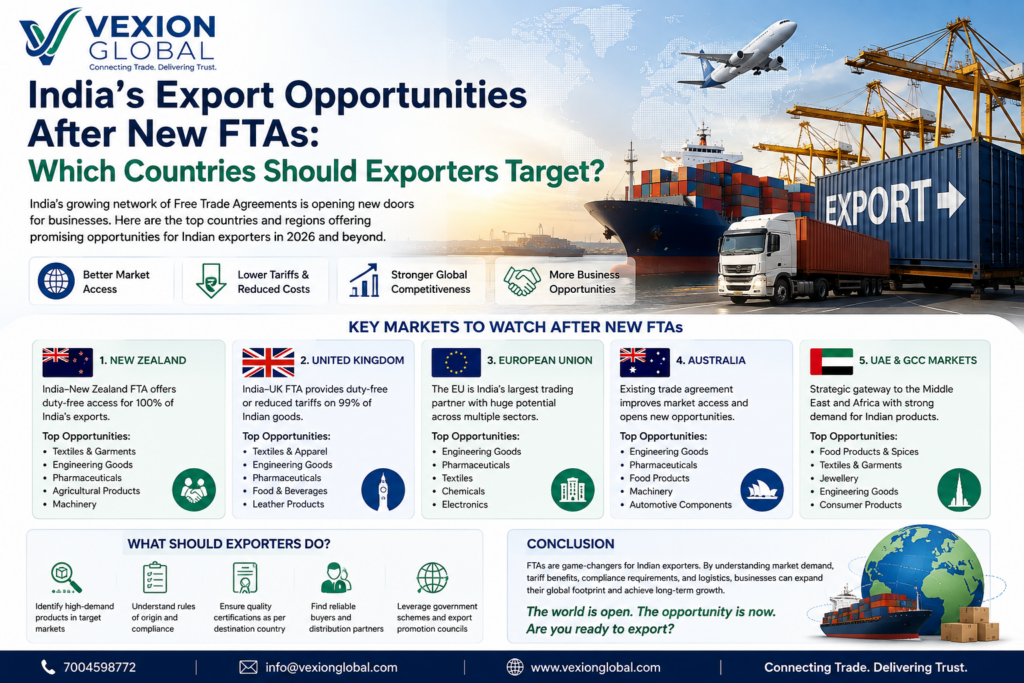
India’s international trade landscape is undergoing a major transformation. Over the past few years, India has expanded its network of Free Trade Agreements (FTAs) and is now focusing increasingly on using these agreements to help Indian businesses reach global markets.
The opportunity has become particularly important for exporters and MSMEs. The Government of India has recently highlighted the need for businesses to make greater use of preferential market access created by FTAs. Recent data also shows increasing use of preferential Certificates of Origin and a wider range of Indian products being exported to FTA partner countries.
For Indian exporters, the important question is no longer simply “Which countries import from India?” but rather:
“Which markets provide the best combination of demand, tariff advantages, logistics and long-term growth?”
In this article, we explore some of the most promising markets Indian exporters should consider in 2026.
What Is a Free Trade Agreement?
A Free Trade Agreement is an agreement between two or more countries designed to reduce barriers to international trade.
Depending on the agreement, exporters may receive benefits such as:
- Reduced or eliminated customs duties
- Preferential market access
- Simplified customs procedures
- Better regulatory cooperation
- Improved access to supply chains
- Greater competitiveness for Indian products
However, exporters should remember that an FTA does not automatically make every product duty-free.
The applicable HS code, tariff schedule, rules of origin and documentation requirements must be checked before claiming preferential treatment.
This is why understanding an FTA properly can be just as important as finding a foreign buyer.
1. New Zealand: A New Market to Watch Closely
New Zealand is one of the most interesting markets for Indian exporters following the signing of the India–New Zealand Free Trade Agreement on 27 April 2026.
India’s Ministry of Textiles has identified significant opportunities in textiles, apparel and made-ups. Potential products include apparel, carpets, fibres, yarn, fabrics, handicrafts and handlooms.
The agreement is particularly attractive because it creates opportunities for Indian businesses in a developed, high-income market.
Products Indian exporters can explore
- Textiles and garments
- Home furnishings
- Carpets
- Handicrafts and handlooms
- Engineering goods
- Pharmaceuticals
- Processed food
- Machinery
- Chemicals
Textile exporters should pay particular attention to New Zealand. Government analysis indicates that the country’s apparel imports include significant demand for cotton and man-made-fibre products, creating potential opportunities for Indian manufacturers.
For exporters, the New Zealand market is therefore worth researching before competition increases.
2. United Kingdom: One of the Biggest New Opportunities
The India–UK Free Trade Agreement entered into force on 15 July 2026, making the UK one of the most important markets for Indian exporters to evaluate right now.
Under the agreement, 99% of Indian goods entering the UK will be duty-free or subject to reduced tariffs, according to the UK government.
This can improve the competitiveness of Indian products in the UK market.
Potential opportunities include:
- Apparel and textiles
- Leather products
- Engineering goods
- Automotive components
- Pharmaceuticals
- Processed food
- Consumer products
- Medical technology
- Chemicals
The agreement also provides for simplified customs and digital trade measures, which can help make cross-border business more predictable.
Why should MSMEs pay attention?
The UK is already a major commercial market for India, and the trade agreement can reduce some of the tariff barriers faced by Indian exporters.
However, exporters should examine their specific product tariff and rules of origin rather than assuming that all products receive identical benefits.
3. European Union: A Long-Term Export Opportunity
The European Union should remain on every serious Indian exporter’s market-expansion list.
India and the EU have substantial existing trade, and negotiations toward a broader trade agreement have been an important part of India’s trade strategy.
The EU offers opportunities across sectors such as:
- Engineering products
- Pharmaceuticals
- Chemicals
- Textiles
- Electronics
- Automotive components
- Food products
- Machinery
- Sustainable products
The European market is different from many emerging markets because buyers often place strong emphasis on quality, traceability, certification, sustainability and regulatory compliance.
Therefore, Indian exporters targeting Europe should not build their strategy around price alone.
A product with strong quality documentation, appropriate certifications, professional packaging and reliable delivery can have a significant advantage.
4. Australia: Strong Potential for Indian Products
Australia is another market where Indian exporters can find attractive opportunities.
India and Australia already have the Economic Cooperation and Trade Agreement (ECTA), which entered into force in December 2022. The agreement has progressively improved market access for Indian products.
The Ministry of Commerce reports that bilateral merchandise trade reached approximately US$24.1 billion in FY 2024–25, while Indian exports to Australia grew by 8%. Key export gains included garments, chemicals, plastics and agricultural products.
The agreement has become even more attractive for exporters because, from 1 January 2026, all Indian exports covered by the agreement, including food, agricultural and marine products, became eligible for zero-duty market access in Australia, subject to the applicable agreement conditions.
Potential export categories
- Textiles
- Garments
- Chemicals
- Plastics
- Agricultural products
- Food products
- Marine products
- Pharmaceuticals
- Engineering goods
- Automotive components
Indian exporters should also watch the ongoing India–Australia CECA negotiations, which aim to deepen economic integration beyond the existing ECTA framework.
5. UAE and the Wider GCC Region
The UAE is already one of India’s most important trading partners and remains an excellent market for exporters.
The India–UAE Comprehensive Economic Partnership Agreement (CEPA) entered into force in May 2022. Government data indicates that Indian exports to the UAE increased from approximately US$28 billion in FY 2021–22 to US$35.6 billion in FY 2023–24.
Important Indian export sectors benefiting from the relationship include:
- Gems and jewellery
- Engineering goods
- Agricultural products
- Electronics
- Food products
- Textiles
- Pharmaceuticals
The UAE can also be strategically important beyond its domestic market.
Because of its strong logistics infrastructure and position between Asia, Europe and Africa, businesses can consider the UAE as a potential regional trading and distribution hub.
Exporters should therefore evaluate not only UAE consumers but also opportunities to work with distributors, wholesalers and re-export businesses serving the wider Middle East and Africa.
How Should an Indian Exporter Choose the Right Market?
Having an FTA or preferential trade arrangement is only one part of the export strategy.
Before selecting a country, exporters should conduct a proper market assessment.
1. Identify Product Demand
Research which products are already being imported by the target country.
Do not select a market simply because it has a trade agreement with India.
2. Check the HS Code
Correct HS classification is essential because tariff benefits are generally product-specific.
An incorrect HS code can result in incorrect duty calculations and compliance problems.
3. Study Rules of Origin
Preferential tariffs normally depend on satisfying the agreement’s rules of origin.
Exporters should determine whether their product qualifies as an originating Indian product.
4. Calculate Landed Cost
A product may have zero customs duty but still be expensive because of freight, insurance, port charges, taxes, compliance costs and distribution expenses.
Exporters should calculate the complete landed cost before quoting to overseas buyers.
5. Understand Certifications
Different markets have different requirements.
Depending on the product, exporters may need to address:
- Product certifications
- Food safety requirements
- Labelling
- Packaging regulations
- Testing
- Environmental requirements
- Health and safety standards
Why FTAs Could Be a Major Opportunity for Indian MSMEs
India’s MSMEs have enormous potential to participate in global trade, but many smaller businesses face challenges related to market research, foreign buyers, compliance, pricing and documentation.
This is why the government’s current focus on better utilisation of FTAs is significant.
In August 2026, the government highlighted the growing commercial importance of FTA partner markets and the need for Indian businesses to make fuller use of preferential market access.
For an MSME, entering a market with preferential tariff access can potentially make its products more competitive compared with exporters from countries without equivalent trade preferences.
But tariff savings alone do not guarantee success.
The exporter still needs:
A competitive product + reliable buyer + correct documentation + regulatory compliance + efficient logistics + competitive pricing.
Common Mistakes Exporters Should Avoid
Indian businesses exploring new FTA markets should avoid these common mistakes:
- Assuming every product is automatically duty-free
- Ignoring rules of origin
- Using an incorrect HS code
- Not checking destination-country regulations
- Choosing a market without studying demand
- Ignoring freight and landed costs
- Failing to verify overseas buyers
- Underestimating payment risks
- Treating an FTA as a substitute for market research
A successful export strategy should begin with research and end with a clear commercial calculation.
Conclusion
India’s growing network of trade agreements is opening an important new chapter for Indian exporters.
New Zealand and the UK are particularly important markets to study in 2026, while Australia and the UAE already provide established preferential trade opportunities. The European Union remains a major long-term market with significant potential across manufacturing, engineering, pharmaceuticals, textiles, electronics and other sectors.
The biggest opportunity for Indian businesses is not simply having access to these markets. It is learning how to use that access effectively.
Exporters who understand tariff benefits, identify products with genuine demand, comply with rules of origin, calculate landed costs and develop reliable overseas buyers can position themselves for sustainable international growth.
For Indian MSMEs, manufacturers and first-time exporters, the message is clear:
Don’t wait for foreign buyers to find you. Identify the right market, understand its requirements and build a structured export strategy around it.
India’s global trade opportunity is expanding—and businesses that prepare early can be better positioned to take advantage of it.