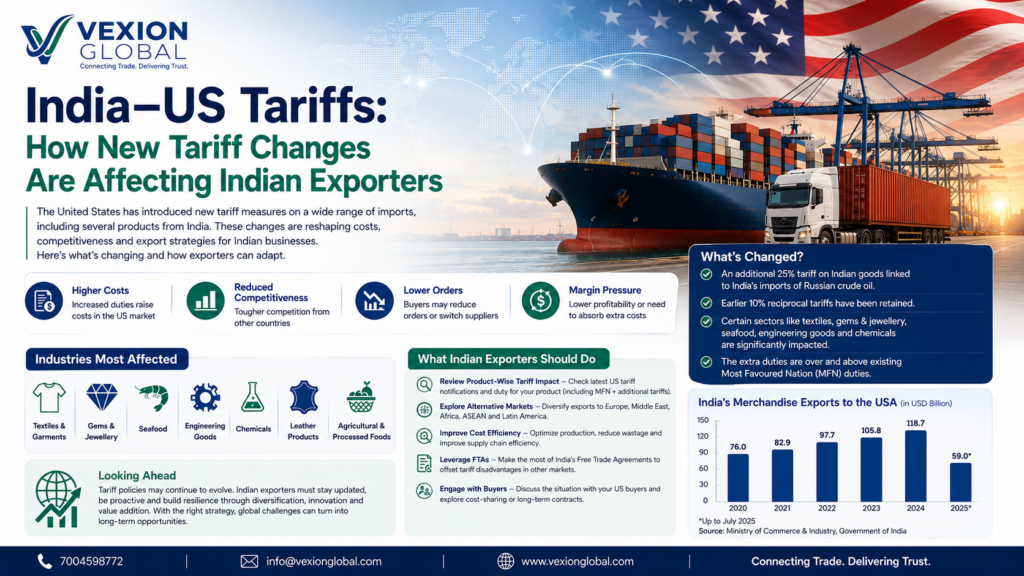
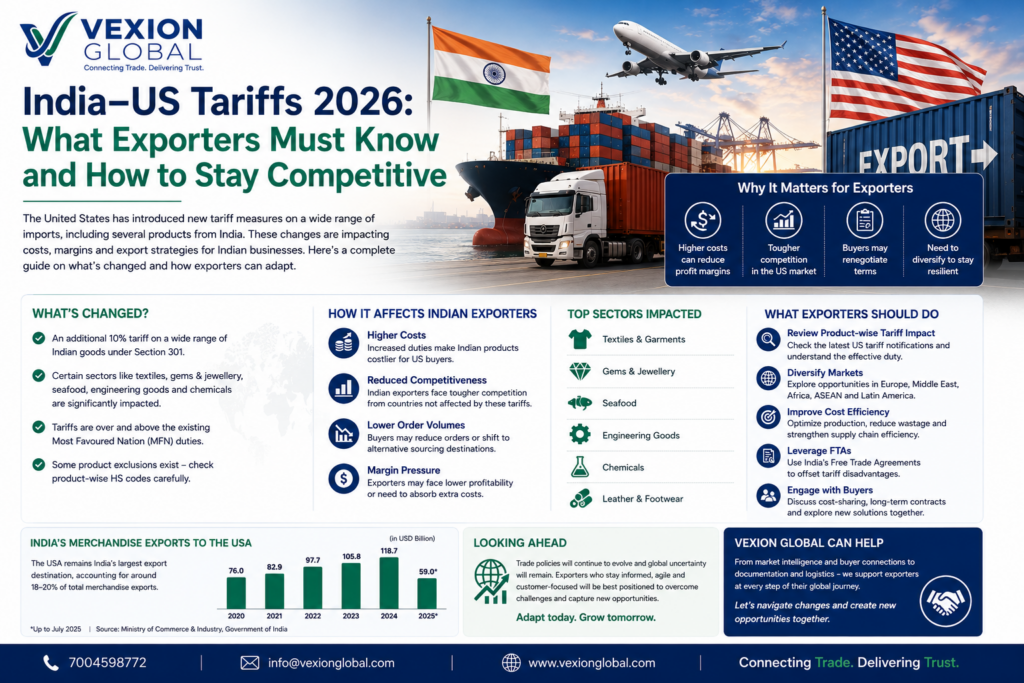
The India–US trade relationship remains one of the most important export corridors for Indian businesses. The United States is India’s largest export destination, making changes in American tariff policy particularly important for Indian manufacturers, traders, MSMEs and agricultural exporters.
In 2026, changing US tariff measures have created both challenges and opportunities. Higher duties can increase the landed cost of Indian products, but India’s strong manufacturing base, established US buyer relationships and growing export capabilities can help businesses adapt.
For exporters, the key question is no longer simply whether tariffs have increased. The more important question is:
How can an Indian exporter remain competitive when the cost of entering the US market changes?
Understanding the Latest India–US Tariff Situation
US trade policy has undergone significant changes, with additional tariff measures affecting imports from several countries, including India.
According to India’s Ministry of Commerce and Industry, the United States announced an additional 10% Section 301 tariff on a wide range of Indian goods in July 2026. The government stated that around 45% of India’s exports to the US remain outside the scope of this additional Section 301 duty, while certain products covered under other US measures are treated separately.
This is an important point for exporters:
There is no single tariff rate for every Indian product entering the US.
The actual duty applicable to a shipment can depend on:
- HS code
- Product classification
- Existing MFN duty
- Additional US tariff measures
- Section 232 measures
- Safeguard measures
- Anti-dumping or countervailing duties
- Product-specific exemptions
Therefore, exporters should calculate their product-specific tariff exposure before quoting prices to American buyers.
How New Tariffs Affect Indian Exporters
1. Higher Landed Costs
The most immediate impact of additional tariffs is an increase in the cost of imported goods for US buyers.
Consider an Indian exporter shipping goods worth $100,000.
If an additional 10% tariff applies, the additional tariff amount could be approximately $10,000, before considering any other applicable duties and charges.
This creates an important commercial question:
Who will absorb the additional cost?
Depending on the contract, it could be:
- The US importer
- The Indian exporter
- The final consumer
- Or a combination of the parties
Exporters should therefore discuss tariff-sharing mechanisms with buyers rather than automatically reducing their own margins.
2. Pressure on Exporter Margins
Indian exporters operating with tight margins may be particularly vulnerable.
For example, an exporter earning a 10% margin may not be able to absorb a significant portion of an additional tariff without making the shipment commercially unattractive.
This makes cost control increasingly important.
Exporters should review:
- Raw-material costs
- Packaging
- Labour efficiency
- Freight rates
- Warehousing
- Inventory
- Documentation costs
- Payment charges
- Production waste
A small improvement in operational efficiency can help offset some of the additional tariff burden.
3. Increased Competition From Other Countries
US importers have many sourcing options.
If an Indian product becomes significantly more expensive because of tariffs, American buyers may compare suppliers from:
- Vietnam
- Bangladesh
- Mexico
- Thailand
- Indonesia
- Turkey
- China
- Other manufacturing economies
This makes total landed cost more important than the exporter’s factory price.
An Indian company may offer a lower FOB price but still lose an order if the final landed price becomes less competitive.
Which Indian Export Sectors Are Most Exposed?
The impact varies considerably from one industry to another.
Textiles and Apparel
India has a major presence in the global textile and apparel industry, making tariff changes particularly important for garment manufacturers.
Exporters can respond by focusing on:
- Higher-value garments
- Sustainable textiles
- Technical textiles
- Private-label manufacturing
- Better product quality
- Faster delivery
- Smaller minimum order quantities
Instead of competing purely on price, exporters can create additional value for US buyers.
Gems and Jewellery
The US is an important market for India’s gems and jewellery industry.
Jewellery exporters need to carefully monitor tariff changes because buyers can compare Indian products with suppliers from multiple countries.
Branding, craftsmanship, customization and quality assurance can help exporters differentiate themselves.
Engineering Goods
Engineering products represent another important export category.
Manufacturers can improve competitiveness through:
- Product innovation
- Automation
- Quality certification
- Better supply-chain management
- Custom manufacturing
- Long-term contracts
Engineering exporters should also evaluate whether specific products are covered by additional US trade measures.
Chemicals
Chemical exporters need to pay particularly close attention to HS classification and US regulatory requirements.
A tariff advantage can be lost if a shipment encounters regulatory or compliance problems.
Leather and Footwear
Indian leather manufacturers can explore opportunities in the US market through:
- Finished leather
- Footwear
- Bags
- Accessories
- Private-label products
Higher-value finished products can offer better opportunities than exporting lower-value raw materials.
Is the US Market Still Attractive?
Yes.
Despite tariff uncertainty, the US remains an extremely important destination for Indian exporters.
India’s merchandise exports to the United States have remained resilient. Business Standard reported that India’s exports to the US increased strongly during 2026, while the US continued to account for a significant share of India’s overall merchandise exports.
This demonstrates that tariff changes do not necessarily mean American buyers will immediately stop purchasing Indian products.
There are structural advantages that continue to support India:
- Large manufacturing base
- Skilled workforce
- Competitive production costs
- Established Indian suppliers
- Diverse product range
- Strong pharmaceutical industry
- Engineering capabilities
- Textile expertise
- Growing electronics manufacturing
The objective should therefore be adaptation rather than abandoning the US market.
How Indian Exporters Can Stay Competitive
1. Conduct Product-Wise Tariff Analysis
Exporters should identify their exact HS code and determine the complete duty structure applicable to their product.
Don’t rely on headlines such as “India faces a 10% tariff.”
The actual commercial impact can be very different from one product to another.
2. Renegotiate With US Buyers
Exporters should communicate openly with buyers about tariff changes.
Possible approaches include:
- Sharing tariff costs
- Revising product prices
- Long-term contracts
- Volume-based discounts
- Adjusting shipment quantities
- Changing product specifications
- Negotiating delivery terms
A transparent approach can help preserve long-term buyer relationships.
3. Diversify Export Markets
One of the most effective ways to reduce dependence on US tariff policy is to develop additional markets.
Indian exporters should consider opportunities in:
Europe
The European market offers opportunities in engineering, pharmaceuticals, textiles, chemicals, food and electronics.
United Kingdom
The India–UK trade agreement has created additional opportunities for Indian exporters.
Australia
Indian businesses can benefit from preferential trade access under the India–Australia ECTA.
New Zealand
India’s recent trade engagement with New Zealand has created significant interest in expanding agricultural and manufactured exports.
Middle East
The UAE, Saudi Arabia, Qatar and other GCC markets remain attractive for Indian food, textiles, engineering and consumer products.
Canada
Canada is becoming particularly interesting as trade tensions between Canada and the US reshape sourcing patterns.
4. Look at Canada as an Emerging Opportunity
Canada has recently become a particularly interesting market for Indian exporters.
According to recent analysis, India’s goods exports to Canada increased from approximately $3.8 billion in FY2022 to $4.7 billion in FY2026, while bilateral trade negotiations continue. India and Canada are targeting substantial growth in two-way trade by 2030.
Canada’s changing trade relationship with the US could create additional openings for alternative suppliers.
Potential Indian export sectors include:
- Pharmaceuticals
- Textiles
- Agricultural products
- Engineering goods
- Food products
- Consumer goods
- Technology-related products
The opportunity is still developing, but exporters should monitor the India–Canada CEPA negotiations closely.
5. Move Toward Value-Added Products
Tariff pressure makes commodity-based competition more difficult.
Indian businesses can increase their competitiveness by moving up the value chain.
For example:
Cotton → Fabric → Finished Garment → Branded Garment
or:
Mango → Mango Pulp → Packaged Beverage → Branded Product
or:
Spices → Processed Spice → Custom Blend → Retail Brand
Value addition can create differentiation and potentially improve margins.
6. Improve Supply-Chain Efficiency
Exporters should examine their complete supply chain rather than focusing only on manufacturing costs.
Important areas include:
- Container utilization
- Freight negotiations
- Port selection
- Inventory management
- Packaging efficiency
- Warehousing
- Delivery schedules
- Digital documentation
Efficient logistics can become a competitive advantage when tariffs increase.
Why Buyer Relationships Matter More Than Ever
When trade conditions become uncertain, strong relationships with international buyers become extremely valuable.
A US importer who has worked with an Indian supplier for years may be more willing to negotiate than a buyer sourcing from a new supplier.
Exporters should therefore focus on:
- Consistent quality
- Reliable delivery
- Transparent communication
- Flexible order quantities
- Professional documentation
- After-sales support
The goal should be to become a strategic supplier rather than simply the cheapest supplier.
What Should New Exporters Do?
Businesses entering the US market for the first time should take a more cautious approach.
Before accepting an order, they should:
- Identify the correct HS code.
- Check current US tariff treatment.
- Calculate complete landed cost.
- Understand US product regulations.
- Verify the buyer.
- Agree clearly on who bears tariff costs.
- Select suitable Incoterms.
- Protect payment risk.
- Prepare correct export documentation.
- Monitor changes in US trade policy.
This can significantly reduce unpleasant surprises after the shipment leaves India.
The Bigger Opportunity for India
Tariff uncertainty can actually accelerate India’s export diversification.
Indian companies that previously depended heavily on the US can use this period to develop customers in Europe, the UK, Canada, Australia, New Zealand, the Middle East, Africa and Southeast Asia.
At the same time, businesses can invest in:
Better quality + value addition + branding + technology + compliance + diversified markets.
This combination can make Indian exports more resilient over the long term.
Conclusion
The changing India–US tariff environment presents a genuine challenge for Indian exporters, but it does not mean that opportunities in the US market have disappeared.
The US remains one of India’s most important export destinations, and Indian businesses continue to have strong advantages in sectors such as pharmaceuticals, textiles, engineering, chemicals, jewellery and manufactured goods.
The most important lesson for exporters is to stop thinking only about tariff rates and start thinking about total competitiveness.
A successful exporter in 2026 will need to understand:
Tariffs + Landed Cost + Buyer Requirements + Compliance + Logistics + Market Diversification.
Businesses that adapt their pricing, improve efficiency, develop stronger buyer relationships and expand into alternative markets will be better positioned to withstand tariff uncertainty.
Tariffs may change the cost of international trade—but smart exporters can change their strategy.
For Indian businesses looking for support with international market research, buyer identification, export documentation, compliance and global trade execution, Vexion Global can help build a structured export strategy.