The India–US trade relationship remains one of the most important corridors for Indian exporters, but changing US tariff policies have created a new layer of uncertainty for businesses selling into the American market.
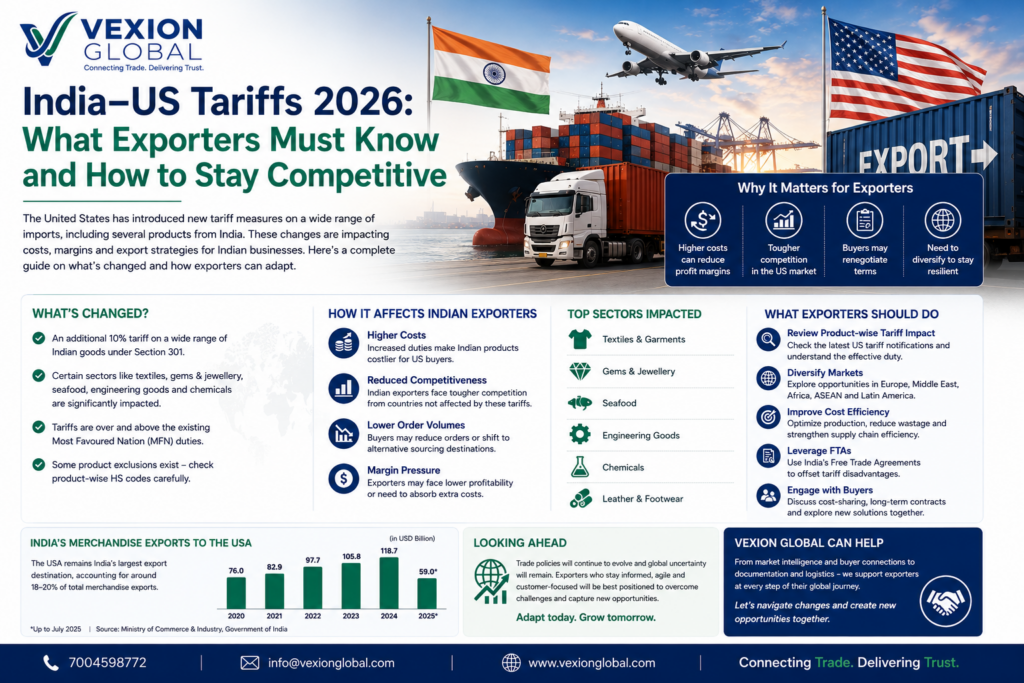
In July 2026, the United States finalized an additional 10% Section 301 tariff on imports from India following its investigation into forced-labour-related policies. This was lower than the 12.5% rate initially proposed. The Indian government says approximately 45% of India’s exports to the US remain outside the scope of this additional Section 301 duty, while the remaining 55% are subject to the additional 10% duty, with certain existing Section 232 products excluded from this measure.
For exporters, however, the impact cannot be understood simply by looking at the headline tariff percentage. The real effect depends on the HS code, existing MFN duty, product category, buyer contracts, freight costs, margins and competing countries.
What Has Changed in US Tariff Policy?
US tariff policy toward Indian products has changed considerably over the past year.
The latest important development came on 23 July 2026, when the US announced its final Section 301 measures. India was placed in the lower additional-tariff tier of 10%, compared with the initially proposed 12.5%.
This additional duty is generally applied on top of the existing applicable MFN tariff, meaning exporters need to calculate the complete tariff burden rather than treating 10% as the total US import duty.
At the same time, some important categories remain outside this particular additional duty. According to the Government of India, generic pharmaceuticals, smartphones and certain other specified products continue to remain outside the additional Section 301 duty, while steel, aluminium and auto parts already covered by Section 232 measures are also excluded from this particular 10% duty.
Important takeaway
There is no single tariff rate applicable to every Indian product entering the US.
Exporters must check their individual product classification and the latest US tariff treatment before quoting prices to American buyers.
How Are Tariffs Affecting Indian Exporters?
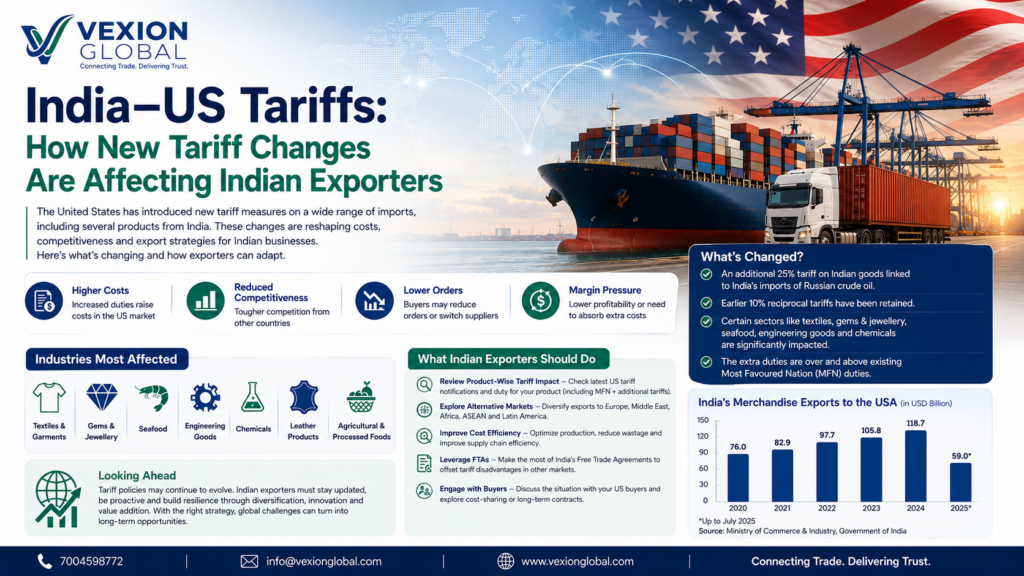
1. Higher Landed Cost
The most immediate impact is an increase in the importer’s landed cost.
For example, if an Indian exporter sells goods worth $100,000 and an additional 10% tariff applies, the additional tariff burden would be $10,000, before considering the underlying MFN duty and other applicable charges.
Who ultimately absorbs this cost depends on the commercial arrangement.
It may be:
- The US importer
- The Indian exporter
- The final consumer
- Or a combination of all three
This is why tariff negotiations are becoming increasingly important in export contracts.
2. Pressure on Exporter Margins
Indian exporters operating with narrow margins may find it difficult to absorb additional duties.
Suppose an exporter was previously earning a 10% margin on a shipment. If the exporter absorbs part of the additional tariff to keep the buyer’s price competitive, the effective profit margin could fall significantly.
Businesses therefore need to review:
Product Cost → Export Price → US Duty → Landed Cost → Buyer Price → Final Margin
A tariff increase can make a previously profitable product commercially unattractive.
3. Indian Products Face Competition From Other Countries
US buyers can compare Indian products with suppliers from Vietnam, China, Thailand, Bangladesh, Mexico, Turkey and other manufacturing countries.
If a competing supplier faces a lower overall tariff burden, an American buyer may have an incentive to switch suppliers.
This makes cost competitiveness increasingly important.
Interestingly, India’s 10% Section 301 rate is lower than the 12.5% rate assigned to several other economies under the same forced-labour-related framework. FIEO has therefore argued that India remains relatively competitive despite the additional duty.
This means the tariff situation is not necessarily negative for every Indian exporter.
For some businesses, India’s relative tariff position could actually create an opportunity.
Which Indian Exporters Are Most Vulnerable?
The impact differs significantly between sectors.
Industries that rely heavily on the US market and operate with price-sensitive buyers can be particularly exposed.
Textiles and Garments
Textile exporters need to monitor tariff changes carefully because the US is a major destination for Indian apparel and textile products.
The Government of India has also stated that a textile-specific mechanism mentioned in the US measures is yet to be established and operationalized, with discussions continuing as part of India-US trade negotiations.
Gems and Jewellery
Jewellery exporters can face significant competition because international buyers have multiple sourcing options.
Even a relatively small increase in landed cost can influence purchasing decisions.
Engineering Goods
Engineering exporters need to evaluate the combined impact of tariffs, freight, raw-material costs and US compliance requirements.
Chemicals
Chemical exporters should pay close attention to product-specific tariff classifications and regulatory requirements.
Food and Agricultural Products
Agricultural exporters need to consider both tariff costs and US food, packaging, labelling and sanitary requirements.
A Major Warning: Product-Specific Tariffs
The recent tariff situation also demonstrates why exporters should avoid relying on a single “India tariff rate.”
Some sectors can face additional measures that are completely separate from the general tariff framework.
A recent example is quartz surface products. The US imposed safeguard tariffs ranging from 25% to 55% on certain quartz surface products from August 15, 2026. India has sought consultations with the WTO regarding the measure.
This is particularly significant because the US accounted for approximately 72.5% of India’s quartz surface-product exports in FY2026, according to data cited by Business Standard.
This example illustrates an important lesson:
Exporters must monitor tariffs at the product/HS-code level rather than relying only on country-level announcements.
Is the US Market Still Attractive for Indian Exporters?
Despite tariff uncertainty, the answer appears to be yes.
The US remains India’s largest export destination, and recent data indicates that Indian exports to the US have remained relatively resilient.
India’s exports to the US were approximately $87.31 billion in FY2025–26, compared with $86.51 billion in FY2024–25. The US continues to account for around one-fifth of India’s exports.
This suggests that American buyers have not simply abandoned Indian suppliers because of tariff changes.
There are several reasons for this.
Indian exporters have advantages in areas such as:
- Product variety
- Competitive manufacturing costs
- Skilled labour
- Established US buyer relationships
- Pharmaceuticals
- Engineering products
- Textiles
- Jewellery
- Specialty manufacturing
- Agricultural and food products
Therefore, the objective for exporters should not necessarily be to leave the US market.
Instead, businesses should develop a more resilient US export strategy.
What Should Indian Exporters Do Now?
1. Calculate Your Actual Tariff
Don’t rely on general news headlines.
Identify the correct HS code and determine:
- MFN duty
- Additional Section 301 duty
- Section 232 applicability
- Safeguard duties
- Anti-dumping/countervailing duties
- Product-specific exemptions
Your actual tariff burden depends on the product.
2. Renegotiate Commercial Terms
Indian exporters should discuss tariff sharing with US buyers.
Possible approaches include:
- Sharing the additional cost
- Revising the export price
- Long-term contracts with agreed tariff clauses
- Volume-based discounts
- Adjusting product specifications
- Changing shipment frequency
The objective is to avoid automatically absorbing the entire tariff increase.
3. Improve Cost Efficiency
When tariffs increase, reducing unnecessary costs becomes more important.
Exporters should review:
- Packaging
- Freight
- Warehousing
- Production waste
- Procurement
- Inventory
- Payment costs
- Logistics routes
Even a 2–3% improvement in operational efficiency can help partially offset tariff pressure.
4. Diversify Export Markets
The US can remain an important market without being the only market.
Indian exporters should explore:
- European Union
- United Kingdom
- Australia
- New Zealand
- UAE
- Saudi Arabia
- Japan
- South Korea
- Africa
- Southeast Asia
India’s expanding network of trade agreements can help exporters develop alternative markets and reduce excessive dependence on a single destination.
5. Move Toward Value-Added Products
Competing purely on price becomes increasingly difficult when tariffs rise.
Indian manufacturers should consider moving toward:
Raw Material → Processed Product → Finished Product → Branded/Value-Added Product
The greater the value proposition, the less dependent the exporter may be on competing solely on the lowest price.
What Does the Future Hold?
The India-US trade relationship is still evolving.
Recent reports indicate that negotiations on a broader India-US trade agreement continue, while businesses remain alert to possible additional tariff actions.
This means exporters should avoid making long-term business decisions based on a single tariff announcement.
Instead, they should build flexibility into their export strategy.
A strong exporter in the current environment should have:
Multiple markets + multiple buyers + efficient logistics + accurate compliance + flexible pricing.
Final Thoughts
US tariff changes have undoubtedly created challenges for Indian exporters, particularly businesses operating on narrow margins or selling products with strong price competition.
However, the situation is not simply a story of declining exports.
India’s exports to the US have remained resilient, and India’s current 10% additional Section 301 tariff places the country in a comparatively lower tier than several other economies affected by the same framework.
The real challenge for Indian exporters is adaptation.
Businesses that understand their product-specific tariff exposure, negotiate intelligently with buyers, control costs, diversify markets and focus on value addition can remain competitive.
For exporters, the message is clear:
Don’t exit the US market because of tariffs. Adapt your strategy to the new trade environment.
For professional assistance with export documentation, international market research, buyer identification, compliance and export strategy, businesses can explore the services offered by Vexion Global.