
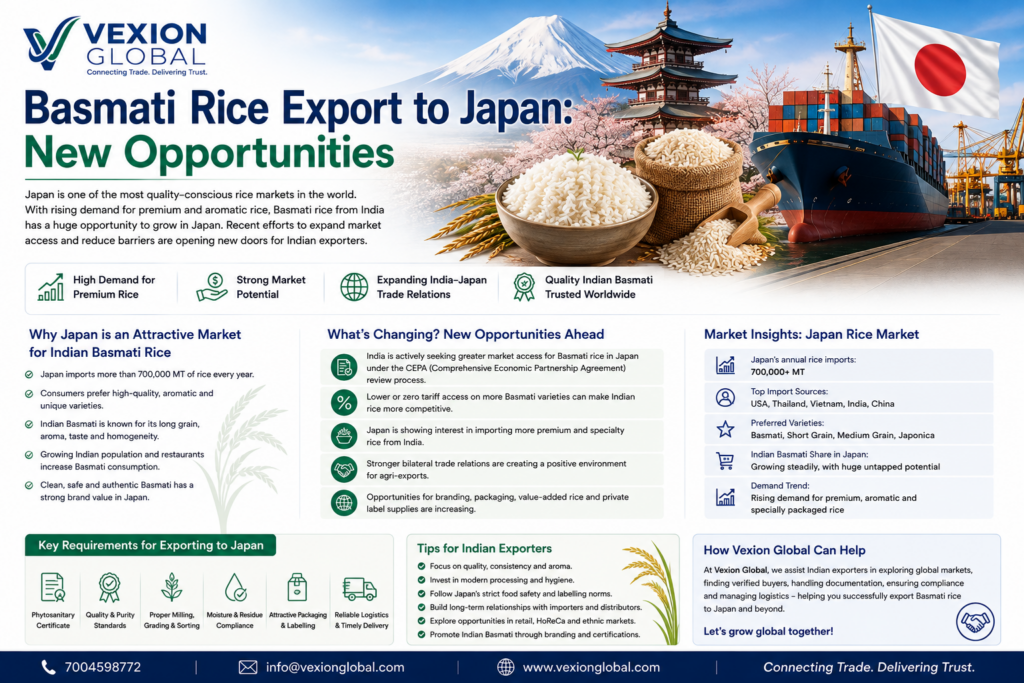
India’s Basmati rice industry is looking toward an important new market opportunity: Japan.
The development is particularly timely because India has recently indicated that it will seek greater market access for Basmati rice in Japan during the review of the India–Japan Comprehensive Economic Partnership Agreement (CEPA). Commerce and Industry Minister Piyush Goyal raised the issue during his Japan visit in August 2026, while also highlighting opportunities for Indian processed-food exports.
For Indian rice exporters, this could become an important opportunity to diversify beyond traditional Basmati markets such as the Middle East and North America.
However, Japan is also a highly regulated and quality-conscious market. Success will depend on more than simply supplying good-quality rice. Exporters will need to understand market access, tariffs, food-safety requirements, quality specifications, packaging, buyer expectations and logistics.
Why Is Japan Important for Indian Basmati Rice?
India is one of the world’s leading Basmati rice exporters. According to APEDA, India exported approximately 6.52 million metric tonnes of Basmati rice during 2025–26, valued at around US$5.67 billion. Major destinations included Saudi Arabia, Iran, Iraq, the UAE, Yemen and the United States.
Japan, however, is not currently among India’s major Basmati export destinations.
That is precisely what makes the market interesting.
Rather than competing only in established markets, Indian exporters can potentially create a new premium market for authentic Indian aromatic rice.
Japan is already a significant rice-consuming country, but its domestic rice industry is highly protected and rice imports operate within a controlled tariff-rate-quota framework. Japan’s 2026 customs tariff schedule shows different treatment for rice imported through government mechanisms and other imports, highlighting why market-access negotiations are particularly important for rice.
Therefore, India’s effort to improve Basmati access is strategically significant.
India–Japan CEPA Review Could Create New Opportunities
India and Japan have operated under their Comprehensive Economic Partnership Agreement since 2011. India has now been pushing for a review to make the agreement more effective and address trade imbalances and non-tariff barriers.
During the latest discussions, India specifically indicated that Basmati rice market access would be raised with Japan.
This does not mean that Japan has already granted new duty-free access to Indian Basmati rice.
Instead, it means that India is seeking improved access as part of the CEPA review.
This distinction is important for exporters.
Potential improvements could include:
- Better tariff treatment
- Greater access under existing import mechanisms
- Reduced trade barriers
- More predictable import procedures
- Opportunities for Indian specialty rice
- Greater recognition of Indian agricultural products
If negotiations eventually produce improved market access, Indian Basmati exporters could become significantly more competitive.
What Makes Indian Basmati Rice Attractive?
Basmati has several characteristics that differentiate it from ordinary rice varieties.
According to APEDA, authentic Basmati is known for its extra-long slender grains, characteristic aroma, soft and fluffy texture, distinctive flavour and ability to elongate substantially during cooking.
These characteristics position Basmati as a premium product rather than simply a staple commodity.
Indian exporters can therefore target customers interested in:
- Premium rice
- Aromatic rice
- Gourmet food
- Indian cuisine
- Specialty food products
- Restaurant and hospitality supply
- Ethnic food retail
- Private-label products
The opportunity could be particularly interesting for exporters who can combine high-quality rice with attractive packaging and strong product positioning.
Potential Basmati Products for the Japanese Market
Indian businesses should not think only about bulk 25 kg or 50 kg rice bags.
Japan could offer opportunities across several formats.
1. Premium Basmati Rice
High-quality aged Basmati can be positioned as a premium imported food product.
2. Organic Basmati Rice
Organic products can appeal to consumers looking for natural and sustainably produced food.
3. Retail-Ready Basmati
Small consumer packs can make Indian rice more accessible to Japanese households.
4. Restaurant-Grade Basmati
Indian restaurants, hotels and food-service businesses can be potential customers.
5. Private-Label Rice
Japanese distributors and retailers may be interested in developing their own branded imported rice products.
6. Specialty and Aromatic Rice
India’s broader rice portfolio may also offer opportunities beyond conventional Basmati.
APEDA has already undertaken promotional activities in Japan for non-Basmati and specialty Indian rice varieties, including varieties such as Chakhao and Mushkbudji. The 2025 campaign included seminars, live cooking demonstrations, consumer promotions and business meetings in Osaka and Tokyo.
This suggests that Indian rice promotion in Japan is already moving beyond a purely commodity-oriented approach.
What Are the Main Challenges?
The Japanese market offers opportunity, but exporters should not underestimate the barriers.
1. Rice Is a Sensitive Sector
The Indian Commerce Minister specifically noted that rice is a sensitive sector in Japan while discussing greater Basmati access.
This means exporters should not assume that negotiations will immediately result in open market access.
2. Tariff and Quota Structure
Japan’s rice import regime is complex.
Japan’s 2026 customs schedule shows a tariff-rate-quota system for rice, with specific treatment depending on the import mechanism. Certain imports under government arrangements can receive different tariff treatment from other imports.
Therefore, exporters should obtain current product-specific tariff information before calculating profitability.
3. Strict Food-Safety Requirements
Japan is known for demanding food-safety and quality standards.
Exporters need to pay close attention to:
- Pesticide residues
- Contaminants
- Grain quality
- Moisture
- Packaging
- Labelling
- Traceability
- Phytosanitary requirements
A shipment that meets Indian requirements may still need to satisfy Japanese import standards.
4. Consistency
Japanese buyers are likely to place significant emphasis on consistency.
An exporter should be able to deliver the same:
grain length + aroma + moisture + cooking characteristics + packaging quality
across repeated shipments.
Documents and Requirements for Indian Basmati Exporters
Indian exporters should ensure that their export documentation and registrations are in order.
APEDA currently lists the following important requirements for rice exports from India:
- Import Export Code (IEC) issued by DGFT
- APEDA e-RCMC
- Phytosanitary Certificate
- Registration-cum-Allocation Certificate (RCAC) for Basmati rice
- Export contract registration and other applicable documentation
APEDA also states that a valid APEDA RCMC is required before applying for the RCAC.
Exporters should always verify the latest destination-specific requirements before shipment because regulations and procedures can change.
How Indian Exporters Can Enter the Japanese Market
A successful strategy should begin with market research rather than immediately approaching buyers.
Step 1: Select the Right Product
Determine whether your Basmati is suitable for:
- Premium retail
- Food service
- Restaurants
- Wholesale
- Private label
Step 2: Study the Japanese Import Structure
Understand the applicable HS classification, tariff, quota and import procedures.
Step 3: Prepare Samples
Japanese buyers may want samples before committing to commercial quantities.
The sample should demonstrate:
- Grain appearance
- Aroma
- Cooking quality
- Packaging
- Consistency
Step 4: Build Professional Packaging
Japanese consumers can be highly attentive to presentation.
Packaging should be:
- Attractive
- Informative
- Durable
- Properly labelled
- Suitable for the Japanese market
Step 5: Find Verified Importers
Potential customers include:
- Rice importers
- Food distributors
- Supermarket suppliers
- Restaurant distributors
- Indian-food distributors
- Private-label businesses
- Food-service companies
Step 6: Calculate Landed Cost
The export price should not be based simply on the FOB price.
Exporters should calculate:
Product Cost + Packaging + Inland Logistics + Port Charges + Freight + Insurance + Import Costs + Distributor Margin = Estimated Landed Cost
This helps determine whether the product can compete in Japan.
Opportunities for Indian MSMEs
The Japanese opportunity is not limited to large rice companies.
Indian MSMEs can potentially participate through specialized products and smaller shipments.
For example, a business could focus on:
Premium Basmati + attractive packaging + private label + specialty food positioning
rather than competing against large commodity exporters.
Smaller businesses can also focus on niche segments such as:
- Organic rice
- Aged Basmati
- Premium long-grain rice
- Specialty Indian foods
- Restaurant supply
- Ethnic grocery
- Online retail
The key is to identify a segment where quality and differentiation matter more than simply offering the lowest price.
Why 2026 Could Be an Important Year
The timing is particularly interesting because India and Japan are actively discussing how to improve the existing trade relationship.
India’s trade deficit with Japan reached approximately $15.4 billion in FY2026, according to government sources cited during the recent discussions. Japan has also acknowledged India’s concerns regarding non-tariff barriers and the need to make the CEPA more equitable.
Greater agricultural market access could therefore become part of India’s broader effort to increase exports to Japan.
For Basmati exporters, this means the market should be watched closely even before any final policy change.
Conclusion
Basmati rice export to Japan represents an emerging opportunity for Indian agricultural exporters in 2026.
India’s Basmati industry already has considerable global experience, with more than 6.5 million tonnes exported during 2025–26.
The major development now is India’s effort to obtain greater market access for Basmati rice in Japan through the CEPA review.
However, exporters should understand that this is an emerging opportunity—not yet a guarantee of expanded or duty-free access.
Businesses that want to enter Japan should prepare early by improving quality control, understanding Japanese regulations, developing professional packaging, identifying reliable importers and monitoring the India–Japan CEPA review.
The biggest opportunity may belong to exporters who can position Indian Basmati not simply as another rice product, but as a premium, authentic and high-quality Indian food product for Japanese consumers and businesses.
For Indian exporters, the message is simple: