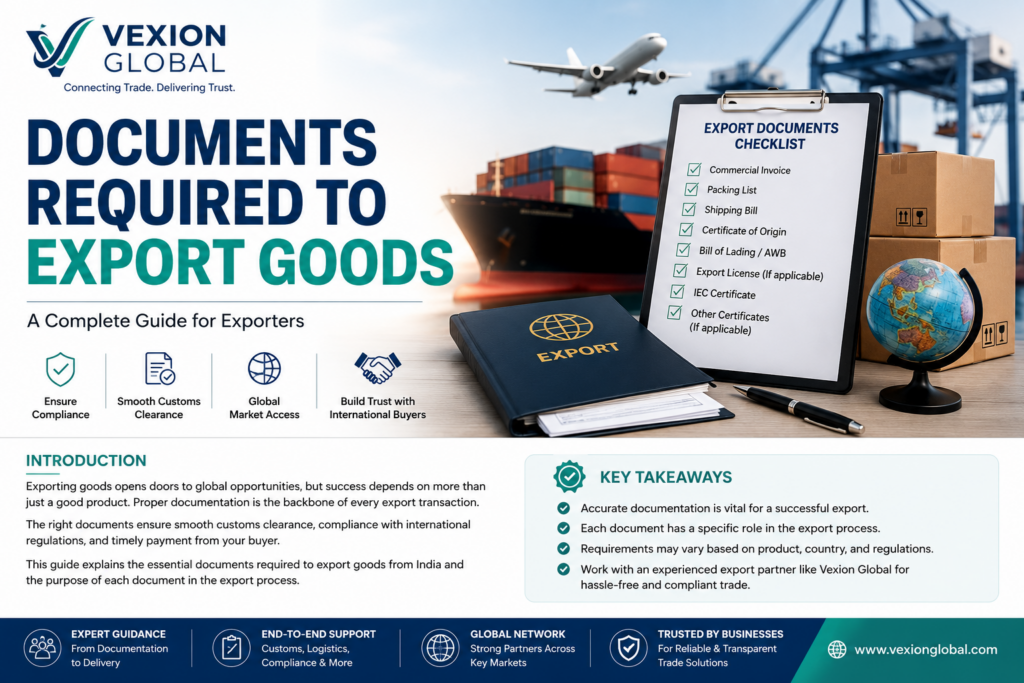
Expanding into international markets is one of the most effective ways to grow a business. However, exporting goods involves more than manufacturing quality products and finding overseas buyers. One of the most important aspects of international trade is ensuring that all export documentation is accurate, complete, and compliant with the regulations of both the exporting and importing countries.
Incorrect or missing export documents can lead to customs delays, shipment holds, financial penalties, additional storage charges, or even rejection of cargo. Whether you are a first-time exporter or an established business, understanding the required export documents is essential for smooth international trade.
In this comprehensive guide, we’ll explain the essential documents required to export goods from India, why they matter, and how they contribute to a successful export transaction.
Why Export Documentation Matters
Export documentation serves as the legal proof of an international trade transaction. These documents enable customs authorities, shipping companies, banks, insurance providers, and buyers to verify the shipment.
Proper documentation helps:
- Ensure smooth customs clearance
- Meet international trade regulations
- Reduce shipment delays
- Facilitate faster payments
- Build trust with overseas buyers
- Minimize legal and financial risks
Every shipment may require a slightly different set of documents depending on the product, destination country, mode of transport, and applicable trade agreements.
Essential Documents Required to Export Goods
1. Commercial Invoice
The Commercial Invoice is the most important export document. It acts as the official bill issued by the exporter to the overseas buyer.
It contains:
- Exporter and buyer details
- Invoice number and date
- Product description
- HS Code
- Quantity
- Unit price
- Total value
- Currency
- Incoterms
- Payment terms
Customs authorities use this document to determine duties, taxes, and shipment value.
2. Packing List
A Packing List provides detailed information about how the cargo has been packed.
It typically includes:
- Number of packages
- Package dimensions
- Gross and net weight
- Packing marks
- Product quantity
- Packaging type
This document assists customs officers, freight forwarders, and warehouse operators during cargo inspection and handling.
3. Shipping Bill
The Shipping Bill is one of the primary customs documents required for exports from India.
It is filed electronically through the Indian Customs system before goods can be exported.
Different types of Shipping Bills include:
- Free Shipping Bill
- Drawback Shipping Bill
- DEEC Shipping Bill
- Export Promotion Shipping Bill
Without an approved Shipping Bill, export cargo cannot leave the country.
4. Bill of Lading (B/L) or Air Waybill (AWB)
These documents serve as proof that the carrier has received the cargo.
Bill of Lading (Sea Freight)
The Bill of Lading acts as:
- Receipt of goods
- Contract of carriage
- Document of title
Air Waybill (Air Freight)
The Air Waybill functions as:
- Cargo receipt
- Transport contract
- Shipment tracking document
The type of transport determines which document is required.
5. Certificate of Origin (COO)
The Certificate of Origin certifies the country where the goods were manufactured.
Many importing countries require this document to:
- Determine preferential duty benefits
- Verify product origin
- Apply Free Trade Agreements (FTAs)
It is generally issued by authorized Chambers of Commerce or designated government agencies.
6. Import Export Code (IEC)
The Import Export Code (IEC) is a mandatory business identification number issued by the Directorate General of Foreign Trade (DGFT).
Without an IEC, businesses generally cannot legally undertake import or export activities from India (subject to applicable exemptions).
7. Export License (If Applicable)
Certain products require an Export License before shipment.
Examples include:
- Defence equipment
- Hazardous chemicals
- Wildlife products
- Restricted agricultural commodities
- Dual-use goods
Exporters should verify whether their products fall under restricted categories before shipping.
8. Letter of Credit (LC) or Purchase Order
Although not required for customs clearance, these commercial documents define the transaction between buyer and seller.
A Letter of Credit provides payment security by ensuring that payment is released only after the exporter submits the required documents through the banking system.
9. Insurance Certificate
Cargo insurance protects exporters and buyers against risks such as:
- Cargo damage
- Theft
- Fire
- Natural disasters
- Transit accidents
Many international buyers require proof of insurance before accepting shipments.
10. Inspection Certificate
Certain countries or buyers require an Inspection Certificate confirming that the goods meet agreed quality standards.
This certificate may be issued by:
- Government agencies
- Independent inspection companies
- Authorized certification bodies
11. Export Declaration Forms
Export declarations contain detailed shipment information submitted to customs authorities.
These declarations help governments:
- Track exports
- Verify compliance
- Monitor foreign trade statistics
- Prevent illegal trade
12. Product-Specific Certificates
Depending on the product and destination country, additional certificates may be required.
Common examples include:
- Phytosanitary Certificate
- Fumigation Certificate
- Health Certificate
- Veterinary Certificate
- Certificate of Analysis
- BIS Certification
- CE Certificate
- MSDS (Material Safety Data Sheet)
Requirements vary according to product category and importing country regulations.
Additional Documents That May Be Required
Certain export transactions may also require:
- GST Invoice
- LUT/Bond Documentation
- Bank Realization Certificate (BRC/e-BRC)
- ARE-1 (where applicable)
- Export Contract
- Freight Invoice
- Dangerous Goods Declaration
- Warehouse Receipt
- Customs Authorization Letter
The exact documentation depends on the nature of the shipment.
Common Mistakes Exporters Should Avoid
Many export delays occur due to documentation errors rather than transportation issues.
Common mistakes include:
- Incorrect HS Codes
- Mismatch between invoice and packing list
- Missing signatures
- Incorrect consignee details
- Wrong Incoterms
- Incomplete product descriptions
- Missing certificates
- Late submission of customs documents
Reviewing documentation before cargo dispatch significantly reduces clearance delays.
Best Practices for Smooth Export Documentation
Successful exporters follow a structured documentation process.
Some recommended practices include:
- Maintain standardized document templates.
- Verify buyer requirements before shipment.
- Confirm destination-country regulations.
- Double-check product classification.
- Ensure consistency across all documents.
- Keep digital and physical copies securely.
- Coordinate closely with customs brokers, freight forwarders, and logistics partners.
- Stay updated on changes in export regulations.
A proactive approach helps avoid costly delays and improves shipment reliability.
How Vexion Global Supports Export Documentation
Preparing export documents can be complex, particularly for businesses entering international markets for the first time. Vexion Global assists exporters with documentation readiness, customs coordination, freight forwarding, cross-border logistics, trade compliance support, and shipment planning. By coordinating the documentation process and working with relevant stakeholders, Vexion Global helps businesses improve accuracy, reduce operational complexity, and support smoother export execution. Regulatory requirements should always be verified against the latest official guidelines and the specific product, destination, and shipment details.
Conclusion
Export documentation is the foundation of successful international trade. Each document serves a specific purpose—from establishing the commercial transaction and proving product origin to enabling customs clearance and ensuring timely delivery.
By preparing accurate, complete, and compliant documentation, exporters can minimize delays, reduce costs, and build stronger relationships with global buyers.
Whether you’re exporting for the first time or managing regular international shipments, investing time in proper documentation is essential for seamless cross-border trade.