International trade between India and Nepal plays a crucial role in the economic growth of both countries. Thousands of consignments move across the border every month, carrying everything from industrial machinery and construction materials to pharmaceuticals, FMCG products, agricultural goods, and consumer products. Among all the trade routes connecting the two nations, the Raxaul–Birgunj Integrated Check Post (ICP) remains one of the busiest and most strategically important gateways.
While the demand for cross-border trade continues to grow, customs clearance remains one of the most critical steps in ensuring that goods reach their destination without unnecessary delays, penalties, or compliance issues.
Many first-time importers and exporters assume that transporting goods across the border is simply a matter of moving cargo from one location to another. In reality, customs clearance is a structured legal process involving documentation, regulatory compliance, inspections, duty payments, and coordination with multiple government agencies.
Understanding this process helps businesses plan shipments more efficiently, reduce logistics costs, and maintain uninterrupted supply chains.
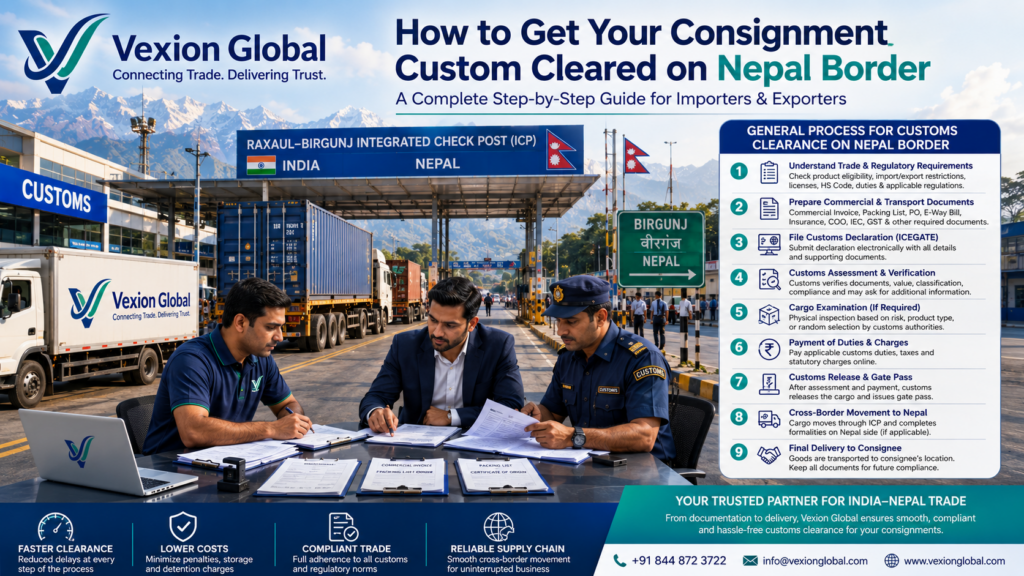
Step 1: Understand the Regulatory Requirements
Before dispatching any consignment, businesses should determine whether their products can legally be imported or exported.
This involves understanding:
- Product-specific regulations
- Applicable import or export restrictions
- Licensing requirements
- Country-specific compliance rules
- Applicable customs duties and taxes
- HS Code classification
Every product falls under a specific Harmonized System (HS) Code, which determines applicable duties and regulatory requirements. Incorrect classification can result in delays, reassessment, penalties, or customs queries.
Professional customs consultants can help businesses correctly classify products before shipment.
Step 2: Prepare All Required Documentation
Proper documentation is the foundation of successful customs clearance.
Depending on the nature of the cargo, the following documents may be required:
- Commercial Invoice
- Packing List
- Purchase Order
- Transport Documents
- E-Way Bill (where applicable)
- Certificate of Origin
- Insurance Certificate
- Import Export Code (IEC)
- GST details
- Product-specific certificates or licenses
Every document must be accurate and consistent. Even small discrepancies between invoices, packing lists, or transport documents may trigger customs verification.
Step 3: Filing the Customs Declaration
After the shipment is ready, customs declarations are submitted through the prescribed electronic systems.
For exports or imports from India, declarations are generally processed digitally through authorized customs platforms.
The customs declaration includes:
- Importer or exporter details
- Product description
- Quantity
- Value
- HS Codes
- Country of origin
- Transport details
- Supporting documentation
Once submitted, customs authorities review the declaration before initiating the assessment process.
Step 4: Customs Assessment and Verification
After filing, customs officials evaluate the submitted documents.
During this stage, authorities verify:
- Product classification
- Declared value
- Applicable duties
- Import permissions
- Compliance requirements
- Documentation accuracy
If additional clarification is required, customs officers may request supporting documents or further information from the importer, exporter, or customs broker.
Accurate documentation significantly reduces processing time.
Step 5: Cargo Examination (If Required)
Not every shipment undergoes physical inspection.
However, customs authorities may examine cargo based on:
- Risk assessment
- Product category
- Random selection
- Compliance history
- Documentation discrepancies
During examination, officials compare the physical goods with submitted documentation.
If everything matches, the shipment proceeds to the next stage.
Step 6: Payment of Customs Duties and Charges
Once customs assessment is completed, applicable duties, taxes, and statutory charges must be paid before cargo can be released.
The amount depends on factors such as:
- Product classification
- Customs value
- Applicable exemptions
- Trade agreements
- Government notifications
Timely payment helps avoid unnecessary delays and additional storage costs.
Step 7: Customs Release and Gate Pass
After successful assessment and payment, customs authorities issue the necessary clearance allowing cargo to leave the customs area.
This stage includes:
- Customs release
- Gate pass generation
- Documentation verification
- Authorization for cargo movement
Once released, the cargo is ready to proceed toward its destination.
Step 8: Cross-Border Movement into Nepal
For shipments destined for Nepal, transportation continues across the international border through designated Integrated Check Posts such as Raxaul–Birgunj.
Depending on the shipment and applicable regulations, additional customs formalities may be completed on the Nepal side before final delivery.
Efficient coordination between transport providers, customs brokers, and logistics partners helps minimize border waiting times.
Step 9: Final Delivery to the Consignee
After all customs procedures are completed, the cargo is transported to the consignee’s warehouse, factory, project site, or distribution center.
Businesses should retain all customs documentation for future reference, audits, and regulatory compliance.
Proper record management also simplifies future shipments and helps maintain a strong compliance history.
Common Challenges During Nepal Border Customs Clearance
Although the customs process is well-defined, businesses may encounter operational challenges such as:
- Incorrect documentation
- Wrong HS Code classification
- Missing licenses
- Valuation disputes
- Delayed duty payments
- Vehicle congestion
- Regulatory changes
- Communication gaps between stakeholders
These issues can increase logistics costs and delay project timelines.
Working with experienced customs professionals helps businesses identify potential issues before shipments reach the border.
Best Practices for Faster Customs Clearance
Businesses can improve customs efficiency by following a few simple practices:
- Verify all documents before dispatch.
- Use accurate HS Code classifications.
- Ensure invoices and packing lists are consistent.
- Keep all regulatory approvals ready.
- Monitor shipment status throughout transit.
- Maintain proper communication with logistics partners.
- Work with experienced customs clearance specialists.
Planning ahead significantly reduces the likelihood of delays.
Why Professional Customs Clearance Matters
International trade regulations continue to evolve, making customs compliance increasingly complex.
Professional customs clearance partners provide expertise in documentation, regulatory compliance, duty assessment, cargo coordination, and cross-border logistics.
Rather than reacting to customs issues after they arise, businesses can proactively manage risk and improve supply chain efficiency.
This becomes especially valuable for companies handling frequent shipments, time-sensitive cargo, or large-scale industrial projects.
How Vexion Global Supports Cross-Border Trade
At Vexion Global Pvt. Ltd., we specialize in delivering reliable customs clearance and logistics solutions designed to simplify international trade.
Our services include:
- Customs Clearance
- Import & Export Documentation
- Cross-Border Logistics
- Freight Forwarding
- Industrial Procurement
- Trade Compliance Support
- Supply Chain Consulting
- Warehousing & Distribution
- Vendor Identification
- Global Sourcing
With extensive knowledge of India-Nepal trade procedures and a commitment to operational excellence, we help businesses move cargo efficiently while ensuring compliance with applicable regulations.
Conclusion
Successful customs clearance is not just about completing paperwork—it is about ensuring that every shipment complies with regulatory requirements while moving efficiently across international borders.
By understanding each stage of the customs clearance process, businesses can reduce delays, control logistics costs, strengthen compliance, and build more resilient supply chains.
Whether you are importing industrial equipment, exporting manufactured goods, or managing regular cross-border shipments, partnering with experienced customs professionals can make a significant difference to your business operations.
At Vexion Global Pvt. Ltd., our mission is simple: Connecting Trade. Delivering Trust. We are committed to helping businesses navigate the complexities of cross-border logistics with confidence, transparency, and efficiency.
Ready to Move Your Cargo Across the India–Nepal Border?
Whether you’re shipping a single consignment or managing large-scale cross-border operations, Vexion Global offers dependable customs clearance, freight forwarding, and logistics solutions tailored to your business
Contact our team today to discuss your requirements and experience faster, compliant, and hassle-free customs clearance.