International trade has become one of the strongest pillars of India’s economic growth. Thousands of businesses export products ranging from textiles and pharmaceuticals to engineering goods and agricultural commodities across the globe. However, exporting goods is not just about finding overseas buyers. Exporters must comply with several regulatory requirements laid down by the Government of India.
One of the most important requirements for exporters is obtaining an AD Code (Authorized Dealer Code). Without it, exporters may face difficulties in customs clearance, shipment processing, and receiving export incentives.
Whether you are a first-time exporter or an established business expanding into global markets, understanding the AD Code is essential for smooth international trade operations.
This comprehensive guide explains everything you need to know about AD Code registration, its importance, eligibility, required documents, application process, and common mistakes to avoid.
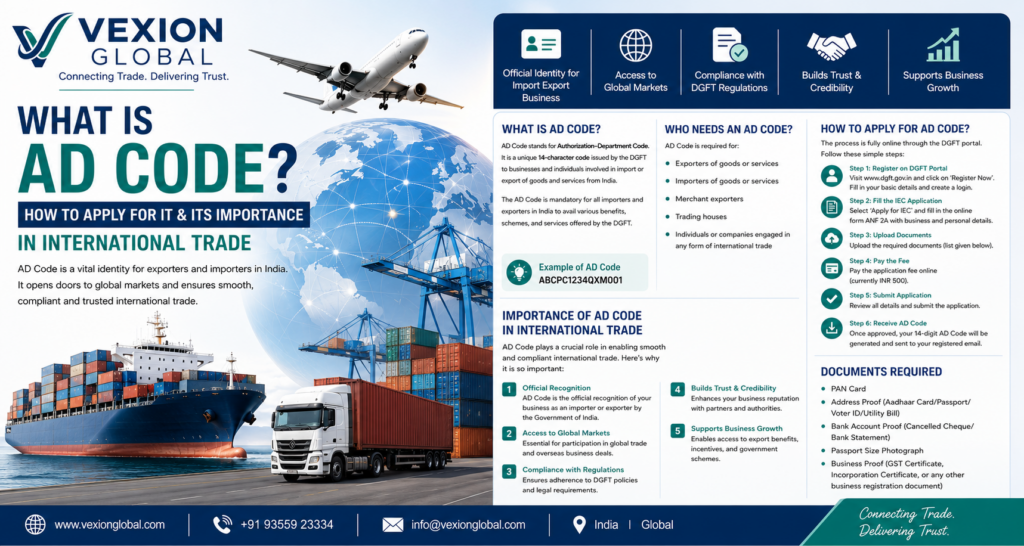
What is an AD Code?
AD Code stands for Authorized Dealer Code.
It is a 14-digit numerical code issued by an Authorized Dealer Bank approved by the Reserve Bank of India (RBI). This code links your business bank account with Indian Customs through the ICEGATE portal and enables customs authorities to process export shipments.
The AD Code is mandatory for registering at the customs port from where exports are made.
In simple words,
No AD Code Registration = No Export Shipping Bill Processing at the Port.
Although your Import Export Code (IEC) allows you to conduct import-export business legally, your AD Code authorizes customs to process export shipments through your bank account.
Why is an AD Code Required?
The Government introduced the AD Code system to create transparency and accountability in international trade transactions.
It helps authorities:
- Verify exporters
- Track export proceeds
- Prevent fraudulent transactions
- Ensure foreign exchange compliance
- Link exports with banking channels
Every export payment entering India must be routed through an Authorized Dealer Bank. Therefore, customs require exporters to register their AD Code before exports begin.
Difference Between IEC and AD Code
Many new exporters assume that IEC and AD Code are the same. They are not.
| Import Export Code (IEC) | AD Code |
|---|---|
| Issued by DGFT | Issued by Authorized Dealer Bank |
| Required to start import/export business | Required for customs port registration |
| Lifetime validity | Valid until bank details change |
| Business identity | Bank authorization for exports |
| Mandatory | Mandatory for export customs clearance |
Both are essential for exporters.
Who Needs an AD Code?
An AD Code is required by:
- Merchant Exporters
- Manufacturer Exporters
- Export Houses
- Star Export Houses
- MSMEs exporting products
- Private Limited Companies
- LLPs
- Partnership Firms
- Proprietorship Businesses
- E-commerce Exporters
- Startups exporting internationally
If you plan to export even a single shipment from India, you should obtain your AD Code before shipping.
Importance of AD Code in International Trade
1. Customs Clearance
Without AD Code registration, customs will not allow exporters to generate shipping bills.
No shipping bill means the goods cannot legally leave India.
2. Mandatory for Port Registration
Each customs port requires exporters to register their AD Code before exports.
For example:
- Nhava Sheva
- Mundra Port
- Chennai Port
- Kolkata Port
- ICD Tughlakabad
- Air Cargo Complexes
If you export from multiple ports, AD Code registration may be required separately.
3. Enables Foreign Exchange Monitoring
All export proceeds received from overseas buyers pass through the Authorized Dealer Bank.
The RBI monitors these transactions through the AD Code.
This ensures transparency and proper foreign exchange reporting.
4. Required for Export Incentives
Government export schemes require successful shipping bill generation.
Without AD Code registration, exporters may face issues claiming benefits under schemes such as:
- RoDTEP
- Duty Drawback
- Other DGFT export promotion schemes
5. Builds Business Credibility
Having an AD Code demonstrates that:
- Your business is verified.
- Your bank account is approved for export transactions.
- You comply with RBI and DGFT regulations.
This enhances credibility with buyers, banks, and logistics partners.
6. Smooth Banking Operations
Banks use the AD Code to:
- Track export proceeds
- Generate Foreign Inward Remittance Certificates (FIRC)
- Report export realization to RBI
- Assist with export documentation
Documents Required for AD Code Registration
The required documents are straightforward.
For Proprietorship
- Import Export Code (IEC)
- PAN Card
- Aadhaar Card
- GST Certificate (if applicable)
- Cancelled Cheque
- Bank Account Details
- Business Address Proof
For Partnership Firm
- Partnership Deed
- IEC
- PAN
- GST Certificate
- Cancelled Cheque
- Authorization Letter
- Address Proof
For LLP or Private Limited Company
- Certificate of Incorporation
- PAN Card
- IEC Certificate
- GST Registration
- Board Resolution/Authorization Letter
- Cancelled Cheque
- Bank Statement
- Address Proof
How to Apply for an AD Code
The application process is relatively simple and usually completed through your Authorized Dealer Bank.
Step 1: Obtain an Import Export Code (IEC)
Before applying for an AD Code, obtain your IEC from the Directorate General of Foreign Trade (DGFT). Without an IEC, banks generally will not issue an AD Code.
Step 2: Open a Current Account
Open a current account with an RBI-authorized bank that handles export-import transactions.
Popular AD Banks include:
- State Bank of India
- HDFC Bank
- ICICI Bank
- Axis Bank
- Punjab National Bank
- Bank of Baroda
- Canara Bank
- Union Bank of India
Step 3: Submit Required Documents
Provide your bank with:
- IEC Certificate
- PAN
- GST Registration
- Business Registration Documents
- Cancelled Cheque
- KYC Documents
Step 4: Bank Verification
The bank verifies:
- Business identity
- IEC details
- KYC compliance
- Bank account authenticity
Step 5: AD Code Issuance
After successful verification, the bank issues an official AD Code letter containing the 14-digit code.
Step 6: Register AD Code on ICEGATE
The exporter (or their customs broker) registers the AD Code on the ICEGATE portal for the customs port from which shipments will be exported.
Once approved, shipping bills can be filed electronically.
How Long Does AD Code Registration Take?
Typically:
- Bank issuance: 1–3 working days
- ICEGATE registration: 1–5 working days
Timelines may vary depending on the bank and customs office.
Is There Any Government Fee?
There is no government fee for obtaining an AD Code itself.
However, banks may have internal documentation requirements, and service providers may charge professional fees if they assist with the application or ICEGATE registration.
Common Mistakes Exporters Should Avoid
Many exporters face delays due to avoidable errors:
- Applying before obtaining IEC
- Using an inactive bank account
- Incorrect GST details
- Mismatch between IEC and bank records
- Uploading incomplete documents
- Forgetting to register the AD Code at the customs port
- Not updating the AD Code after changing banks
Keeping all business records consistent across DGFT, GST, and bank records helps ensure a smooth process.
Benefits of Having an AD Code
- Enables export customs clearance
- Mandatory for shipping bill generation
- Supports RBI compliance
- Facilitates export payments
- Helps claim export incentives
- Enhances business credibility
- Ensures smooth banking transactions
- Required for ICEGATE registration
- Simplifies customs procedures
- Builds trust with international buyers
Frequently Asked Questions (FAQs)
Is AD Code mandatory for exports?
Yes. An AD Code is mandatory for customs port registration and shipping bill generation for exports from India.
Can I export with only an IEC?
No. While an IEC authorizes you to engage in import-export business, an AD Code is required for customs processing of export shipments.
Can one AD Code be used at multiple ports?
Yes, but it generally needs to be registered separately at each customs port where you export.
Does the AD Code expire?
There is no fixed expiry date. However, if you change your Authorized Dealer Bank or bank account, you should obtain a new AD Code and update the registration.
Can I change my AD Code?
Yes. If you switch banks, the new bank will issue a new AD Code, which must then be registered with customs.
Conclusion
An AD Code is far more than a banking formality—it is a vital requirement for every exporter in India. It connects your bank account with customs, enables export shipments, supports compliance with RBI regulations, and helps you access government export benefits.
Whether you are a startup, MSME, manufacturer, merchant exporter, or an established export house, securing your AD Code before dispatching your first shipment can save time, prevent delays, and ensure smooth international trade operations.
At Vexion Global, we help businesses navigate export documentation and compliance with confidence. From IEC registration and AD Code assistance to customs documentation and end-to-end export consultancy, our experts are committed to making your global trade journey seamless.